How a claim gets on the record
Every identifier in the graph has a public page and a map you can walk. What fills that map is claims: a paper supports another, refutes a result, extends a method. Some carry a researcher’s name and some carry a machine label, they are never mixed, and once a signed one is on the append-only log nobody gets to quietly edit it. Including us.
Signing your own citations
Paste a DOI on the main page: preprints, Zenodo deposits, journal papers and datasets all work. The reference list is drafted from open scholarly data (OpenAlex, Zenodo) and offered as candidate claims, and you choose what each citation actually does: supports, refutes, extends, uses a method, uses data, or plain cites. Signing happens server-side under your researcher identity, so there are no keys to download, manage or lose. Each signed claim is public, CC0, timestamped, and chained to every claim before it, so the record can’t be quietly edited later.
The graph has two kinds of edges, and they never mix
Signed
Put on the record by a named researcher under their ORCID iD, cryptographically signed, and appended to a public chained log. The signed tier is young: its early claims are largely the founder seeding the mechanism on his own papers, disclosed on each claim page.
Inferred
Machine sweeps of open scholarly metadata. Useful coverage, labelled as machine work, and a snapshot that inherits the errors of the metadata it was built from. Today’s coverage lives here.
Every answer CiteStamp gives carries a tier. The two coexist on every paper page, and nothing ever silently promotes one to the other.
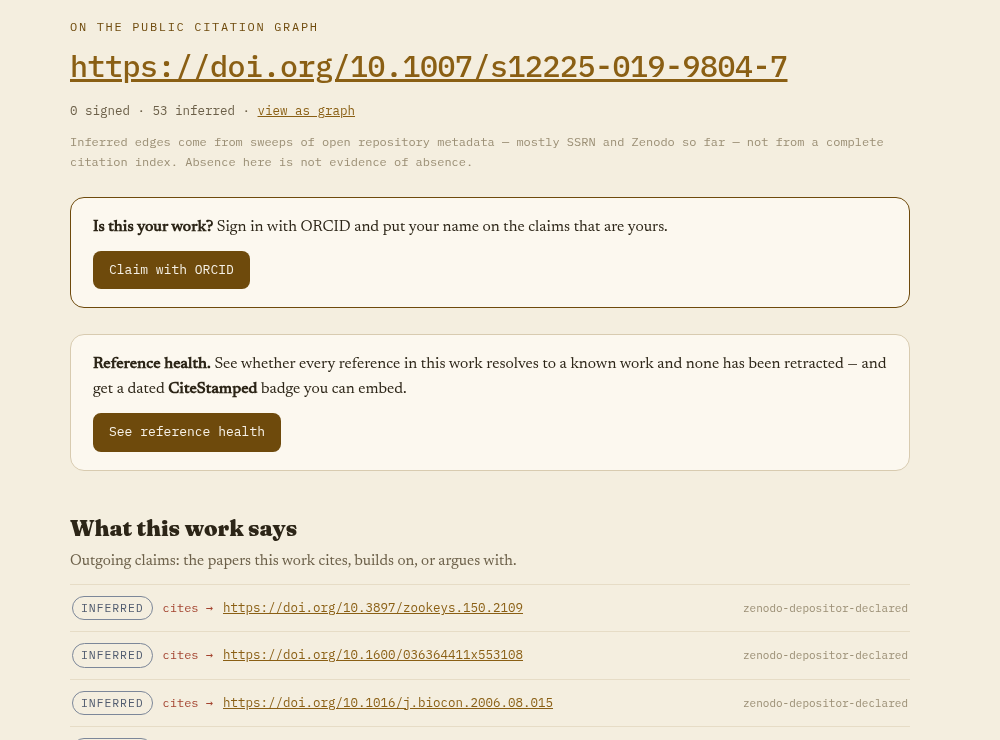
Claiming a paper that is already in the graph
Open citation metadata already maps the citations of millions of papers. If one of them is yours, open its page and follow Claim with ORCID. You sign in with your ORCID iD, tick the citations that are genuinely part of your reference list, and sign them under your name. Signing in proves who you are; whether the paper is yours is checked against the work’s own public metadata, and when the metadata doesn’t list your iD, a human curator reviews the claim instead. Nothing is ever auto-approved on a name match.
The same paper often lives in two places: a preprint server copy and its Zenodo record, say. On the claim page you can also sign that the two records are the same work. Your iD is checked against both records’ metadata. It is a signed claim, not a merge: each record keeps its own page, and a retraction undoes it.

Retraction is public too
Signed something in error? A retraction is itself a signed, public event on the same log: the original line stays, the retraction points at it, and every reader sees both. That is what an append-only record means.
Next: claim your papers · check a reference list · who’s behind it